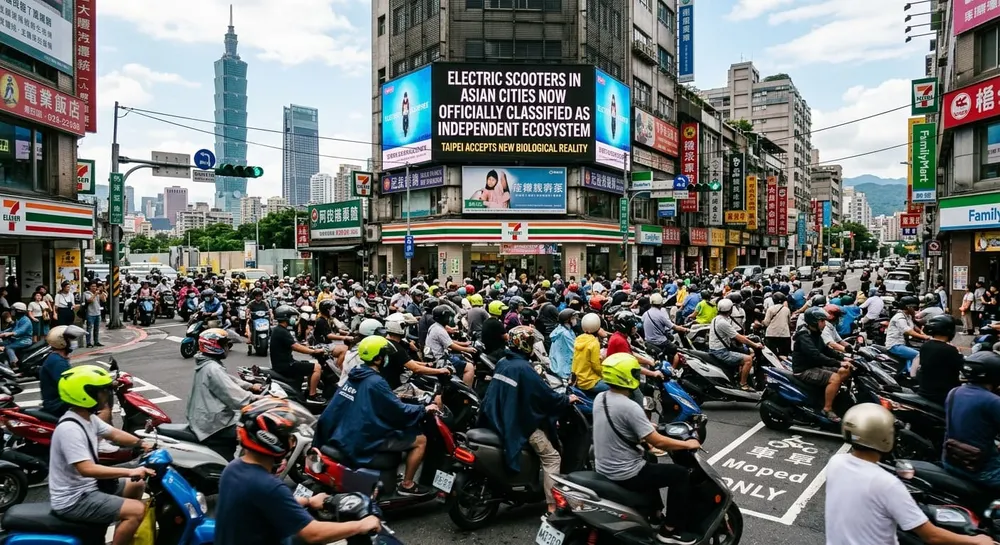
Taipei City, TAIWAN — In a major breakthrough for urban ecology, scientists have reclassified the swarms of electric scooters gliding through Asia’s megacities as a living, breathing natural phenomenon. Researchers confirmed that the silent, two-wheeled battery packs no longer obey standard municipal traffic rules, operating instead on a complex collective instinct similar to migratory starlings or schools of fish.
The humble e-scooter—once a simple way to grab morning iced coffee without breaking a sweat—has evolved into the undisputed apex predator of urban lanes, sidewalks, and pedestrian overpasses across the continent.
New E-Scooter Standards & Features Discovered:
- The Silent Approach System: Scooter motors now operate at a frequency lower than human hearing, allowing riders to manifest instantly out of thin air directly behind unsuspecting pedestrians without warning.
- Infinite Cargo Capacity Theorem: Physicists are still attempting to calculate how a single 125cc-equivalent electric frame can simultaneously carry two adults, a toddler, a folded ladder, three bags of groceries, and a medium-sized dog.
- Autonomous Sidewalk Rights: Local traffic codes have informally ceded all elevated footpaths to delivery riders during peak dinner hours. Pedestrians are advised to step into the shrubbery to avoid impeding order fulfillment.
- Infinite Fleet Expansion: Unlocking a dockless rental scooter instantly summons four more nearby scooters, forming an impassable metallic barrier near subway exits overnight.
Rider and Citizen Reactions
City planners have mostly surrendered to the trend, replacing traditional stoplights with polite suggestion signs. "We tried creating dedicated scooter lanes," said one urban developer in Jakarta. "However, the scooters quickly absorbed the original lanes, the bus lanes, and two lanes of oncoming traffic. They move as one liquid mass now."
E-delivery couriers have welcomed their new status atop the city food chain. "If I tap my brakes even once, someone's bubble tea loses its temperature profile," explained one delivery driver while seamlessly weaving between a city bus and a street food cart at 40 km/h. "We don't need road signs; we navigate purely by instinct and battery percentage."
Environmental groups have offered cautious praise, noting that while carbon emissions are down, the overall heart rate of local pedestrians walking past alleyway intersections has increased by an average of 400%.