The American roadway is a marvelous laboratory of modern living, a truth that has not escaped the eagle-eyed engineers currently designing the next generation of four-wheeled domiciles. With traffic moving at a brisk 45 miles per hour and the average citizen spending ever-increasing percentages of his natural life behind a steering wheel, a profound realization has gripped the automobile industry: the time is nearly here when the home is simply a poorly-designed, stationary car.
Why, then, must a motorist, mid-journey, suffer the indignity of pulling over to eat? Or worse, waiting until he arrives at a destination that has neither headlights nor a chrome-plated grill?
The Coming Galley
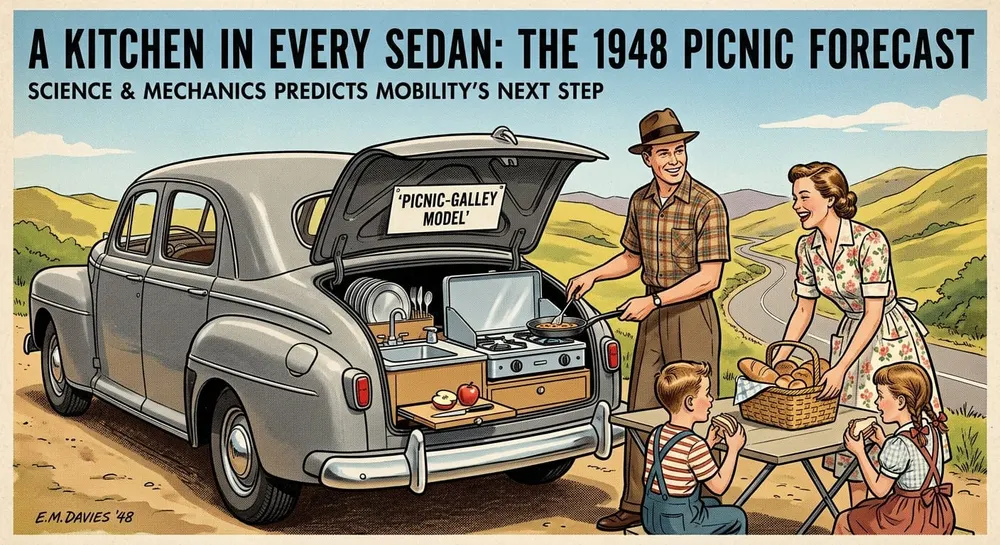
The answer, detailed in a series of ambitious patent filings for 1948, is the all-in-one culinary dashboard. Automotive scientists are now finalizing plans to integrate a two-burner stove where the radio once sat, recognizing that a radio cannot cook a pork chop. Engineers are confident they can harness the latent heat of the engine manifold, channeling it directly into a small oven designed to slow-roast a holiday turkey over the course of a normal commute to the office. The glove compartment is slated to be replaced by a four-slice toaster and a condensed pantry.
The Mobile Homestead
Furthermore, it is predicted that by the close of the decade, rear seating will become a charming artifact of a simpler time, replaced instead by a pressurized water tank and a functional, folding kitchenette. The central idea is to minimize the amount of time the automobile's personality—its "spirit of travel"—is forced to wait for its human occupants to exit. When you live in your car, your car is finally whole. Why should a perfectly good sedan, a vehicle of drive and purpose, sit empty on a driveway while its family is inside, reading? A man cannot take a tight corner in a bungalow. But with the 1948 forecast, he can certainly scramble an egg while merging onto the highway.