
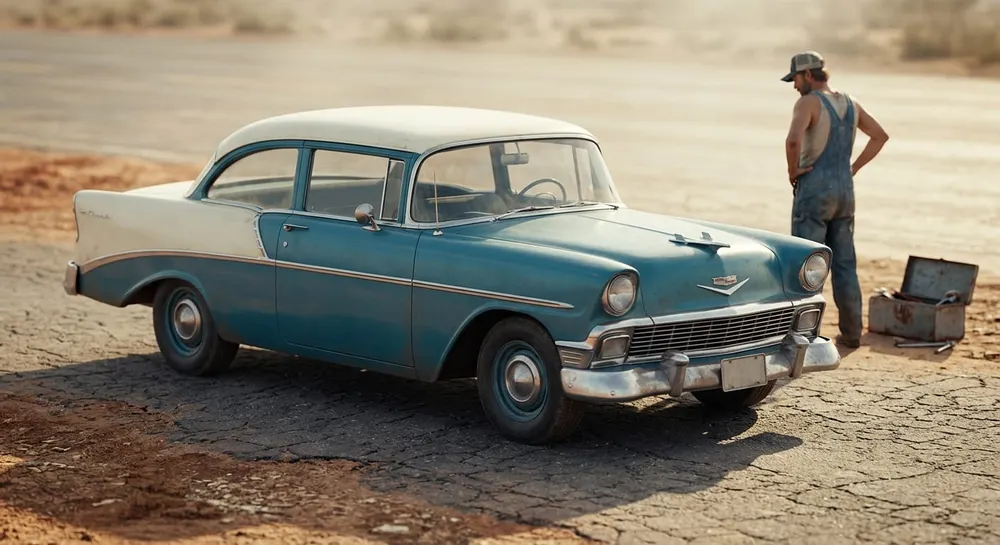
Detroit, MI — Physicists and automotive historians confirmed today that the 1956 Chevrolet 210 Two-Door Sedan does not obey the laws of mechanics; the laws of mechanics yield to the 1956 Chevrolet 210.
While the Bel Air took the credit and the 150 took the budget cuts, the 210 2-door simply took names. Stripped of excess chrome trim to reduce drag on its relentless pursuit of absolute asphalt dominance, the mid-tier legend has spent the last seven decades terrorizing garage bays and quarter-mile strips alike.
Mechanics report that opening the hood of a '56 210 does not reveal an engine bay; it reveals an absolute refusal to break down. When a 265 Turbo-Fire V8 experiences an oil leak, the oil bleeds back into the engine out of sheer respect.
"I tried to adjust the timing on one last Tuesday," reported local mechanic Dave Miller. "I hooked up the light, but before I could rotate the distributor, the engine block turned itself to 8 degrees top-dead-center and growled at me. I apologized and gave it a fresh tank of leaded gasoline."
Facts Surrounding the Legend of the '56 210:
- Speed Limits: The 210 does not hit speed bumps; the road lowers itself out of courtesy.
- Fuel Efficiency: Gasoline doesn't burn inside a 210's carburetor; it surrenders its chemical energy willingly.
- Rust: Rust attempted to eat the rear quarter panel of a '56 210 in 1974. The rust caught tetanus.
- Collisions: If a '56 Chevy 210 hits a brick wall, the wall gets a structural damage estimate.
- Parking: A 210 2-door never has a dead battery; it simply chooses when the alternator deserves a rest.
The classic Tri-Five silhouette remains an icon of American muscle, but experts warn drivers never to stare directly into the double-bar grille of a two-door 210 for more than five seconds unless they are prepared to buy it a set of rear slicks.